Think Sphere and the Lessons Other Banks Paid For
Fifteen years of bank-built ventures, labs and accelerators have produced a playbook. Spuerkeess’s new innovation company can start from it, and one partnership would complete the design
Pascal Bouvier | Managing Partner | MiddleGame Ventures | September 2026
On 4 May 2026, Spuerkeess incorporated Think Sphere SA: a wholly owned innovation company with one million euros of capital, a chief executive who takes office on 1 October on a six-year mandate, a board drawn from the bank’s own management, seven profiles to recruit, and a remit that covers digital assets, embedded finance and marketplaces, and efficiency through artificial intelligence and regtech. [1,2] This is good news for Luxembourg, and I want to say why before anything else. A State-owned bank with a CET1 ratio of 26.9% and a net profit of €529.5 million in 2025 has chosen to build an instrument for experimentation rather than buy a consultant’s roadmap, [3] and it has done so with legal and compliance in the room from day one, on the principle, in the words of its head of legal, that agility does not mean removing controls but changing how they are exercised. [1] In a country that has deliberately chosen an Innovation Hub at the CSSF rather than a regulatory sandbox, a wholly owned company is the only structural way to experiment differently, so the form is right too. [4] Most of the banks that tried this over the past fifteen years started from a weaker position.
Those fifteen years are the point of this article. Banks have been building innovation companies, greenfield digital banks, accelerators, labs and intrapreneurship programs long enough, and loudly enough, that the outcomes can now be read. I went through some 175 of them across Europe, the United States and Asia, from DBS’s transformation to Commerzbank’s neosfer, from Goldman’s Marcus to La Banque Postale’s Ma French Bank, and separated the ones that demonstrably worked from the ones that did not. The pattern is clear enough to be turned into a playbook, and the playbook bears directly on the three things Think Sphere has said it will do. It also points to one addition that the vehicles which beat the odds all had in some form, and that Think Sphere can add more easily than most: a partner whose profession is finding, selecting and backing fintech companies.
The unit of success is the bank, not the satellite
The most useful finding in the record is where the largest gains came from. DBS, the reference case of the decade, disclosed in 2017 that a digital customer produced S$1,306 of income against S$568 for a traditional one, at a cost-income ratio of 34% against 55% and a return on equity of 27% against 19%; by 2022 the return-on-equity gap was 39% against 24%. [5,6] SMBC’s Olive, an account launched inside the bank’s main app in March 2023, reached 7.5 million accounts and a ¥80 billion profit contribution in three years. [7] KBC’s assistant Kate answers 70% of 5.8 million users’ queries without a human and, in its chief executive’s words, does the work of 300 people. [8] Bank of America’s Erica passed two billion interactions, and its staff-facing sibling EricaAssist now guides 18,000 of the bank’s own agents. [9] None of these is a separate company. All of them run on the parent’s license, balance sheet and distribution, and all of them are measured in the parent’s numbers. For a vehicle designed, as Think Sphere is, to stay close to its parent and to work inside the regulatory perimeter, that is the right starting point.
The standalone banks that worked needed three things at once: a market the parent could not otherwise reach, a distribution partner that made customer acquisition cheap, and a budget measured in years. Chase UK, launched in 2021 in a country where JPMorgan had no retail presence, passed three million customers and £25 billion of balances and reported a profit before tax of £158.9 million for 2025 after years of guided losses. [10] BoursoBank lost money every year until 2023, including a negative contribution of around €220 million in 2022 while it added 1.5 million clients; it now has 9.1 million and targets more than €300 million of profit in 2026. [11] Trust Bank in Singapore reached a million customers in two and a half years and its first monthly profit in March 2026, after losses of S$128 million and S$93 million, with more than 70% of new clients arriving by referral through its grocer partner’s loyalty base. [12] Nickel, bought by BNP Paribas in 2017 and left to run its own core system through 8,000 tobacconists, earned €17.7 million on €204.9 million of revenue in 2024 and paid its first dividend. [13] Where one of the three conditions was missing, the story usually ended in the next section.
Venture building, the genre Think Sphere belongs to, produced durable assets in two ways, and neither was a consumer brand. The first is the spin-in. Standard Chartered offered in May 2026 to buy out the minorities in Zodia Custody and fold it into the bank; [14] CBA’s Unloan graduated from x15ventures into a division of the bank; [15] JPMorgan’s in-house Onyx became Kinexys and now moves more than $5 billion a day; [16] Société Générale’s SG-Forge, which began as an employee’s project in 2018, issues the second-largest euro stablecoin under a MiCA license. [17] The second is the spin-out that attracts other people’s capital: Proxymity, conceived inside Citi, raised its Series A from eight institutions, [18] and SurePay, born inside Rabobank, took a Carlyle growth investment in 2025. [19] Every one of these is infrastructure, and every one serves the parent’s own clients. Digital assets, the first of Think Sphere’s pillars, is precisely where these wins were made.
The last genre with an almost unbroken record is the collective utility. Zelle moved $1.2 trillion in 2025 through more than 2,300 banks and shut its own app because the distribution that mattered was inside the members’ apps; [20] Twint handled 901 million Swiss transactions; [21] Bizum has 30.6 million Spanish users. [22] Luxembourg knows this genre better than most. LUXHUB, i-Hub, Payconiq and now the Qivalis euro-stablecoin consortium are all mutualized, and Spuerkeess is in all four. [23,24] Few banks arrive at venture building with that habit already formed.
What the closures teach
The closures are more numerous, and the reasons their owners gave converge, which is what makes them useful. JPMorgan’s Finn closed in 2019 with 47,000 customers, half of them already Chase customers. [25] NatWest’s Bó lasted six months and 11,000 customers before a new chief executive described its closure as “prioritisation choices”. [26] HSBC’s Zing, three years in development, lasted sixteen months in the market. [27] Ma French Bank reached 675,000 clients against a target of a million, lost €255 million between 2018 and 2022, and was put into run-off two months after a new chief executive arrived because it “n’a pas atteint la rentabilité et n’a pas encore trouvé son modèle économique”; 28% of its clients followed it into the parent. [28] Belfius and Proximus closed Banx because it proved “very difficult to develop a new banking app and brand, and to achieve sufficient scale in an already mature market”. [29] Goldman kept the deposits of Marcus and exited consumer lending, cards and robo-advice; the segment that housed them lost roughly $7 billion before tax between 2020 and 2024, and David Solomon’s own verdict was “we tried to do too much, too quickly”. [30] In 2022, fewer than 5% of neobanks of any parentage were at breakeven. [31] The common thread is a consumer brand launched into a mature market without a distribution edge, which is a thing Think Sphere has not announced and, on its stated pillars, does not need.
The innovation companies had a harder time than their products, and their experience is the most directly relevant. x15ventures publishes its own scorecard: six closures among fourteen ventures built. [15] NatWest’s autonomous venture division had been dismantled by 2022; RBC Ventures was merged into RBCx the same year; [34] ING folded its innovation unit into group strategy; [35] Commerzbank closed neosfer, the former main incubator, in June 2026 after thirteen years, under a cost program; [36] Barclays wound down Rise after ten years and 120 graduates; [37] and BGL BNP Paribas closed Lux Future Lab in January 2021, explaining that “the greatest value add that the bank can offer has pivoted to supporting startups as a financial partner”. [38] DBS, with resources few banks have, scrapped its own accelerator in 2018 after finding that 78% of the accelerators launched in Singapore over the previous three years were defunct. [39]
Two regularities run through the list, and both are design problems rather than failures of talent or will. The trigger for closure is almost always a change of chief executive or a cost program, and the interval between trigger and closure is six to eighteen months. And the programs that closed reported inputs: visitors, ideas, startups engaged, hackathon prototypes. Capgemini found in 2017 that 87% of large companies had an innovation center but only 17% saw innovation happening beyond it; [40] Steve Blank called the result innovation theater, activities that “shape and build culture” but “rarely deliver shippable/deployable product”. [41] Both problems have known solutions, and Think Sphere has already adopted some of them.
The playbook, compressed
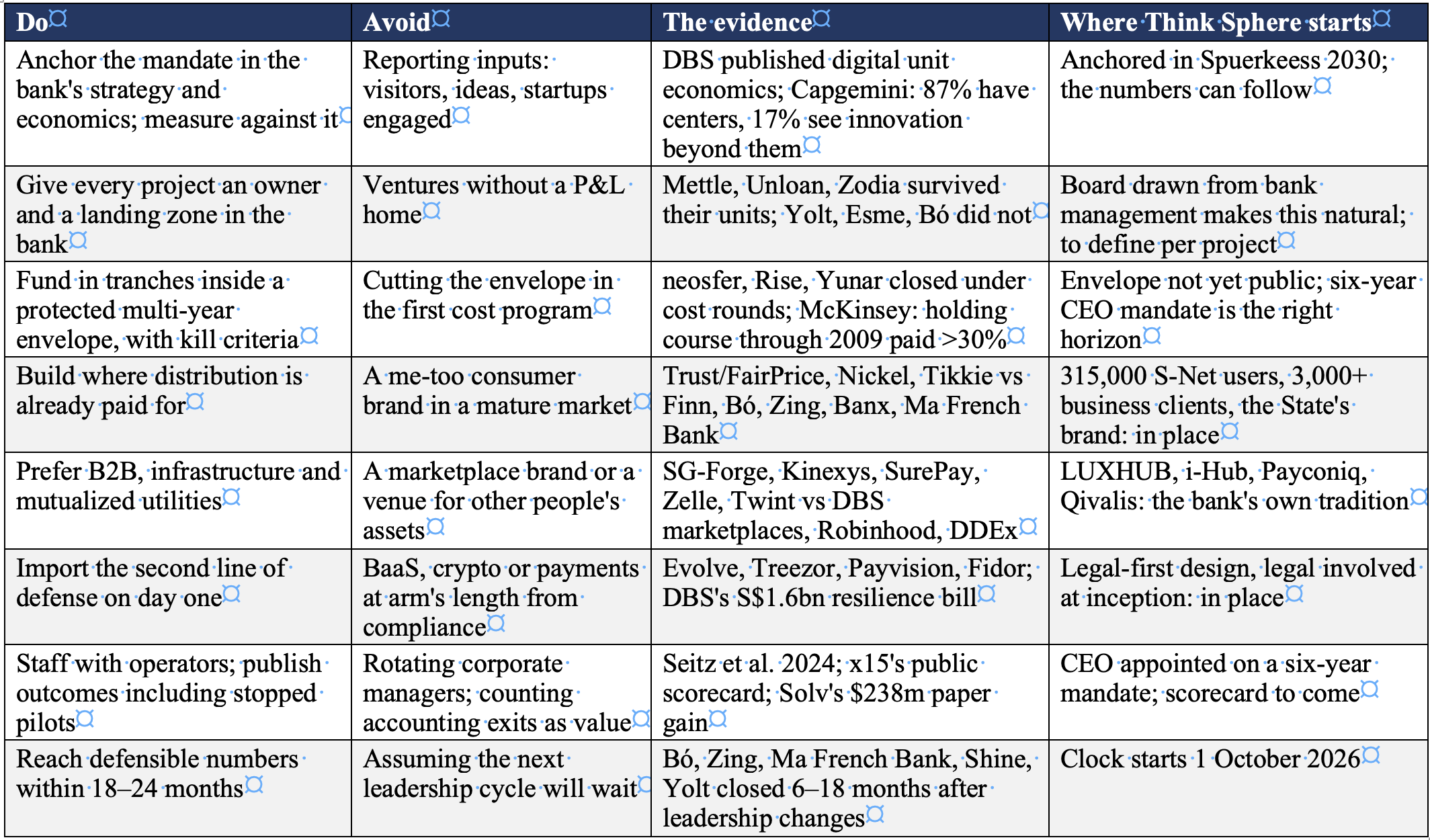
If I compress the record into a playbook, the dos are these, and it is worth noting how many Think Sphere already has in place. Anchor the mandate in the parent’s own strategy and economics, and put a number on each gap the vehicle exists to close: Think Sphere is anchored in Spuerkeess 2030, and the numbers can follow. Choose one objective per vehicle, either feeding the bank or building businesses outside it, because the governance, metrics and people differ. Give every project a business-unit owner and a landing zone in the bank before it starts, because Mettle, Unloan and Zodia survived their units and Yolt, Esme and Bó did not; a board drawn from the bank’s own management makes that easier, not harder. Fund in tranches against milestones, inside a multi-year envelope the annual cost round cannot touch, with the kill, integrate and spin-out criteria written before launch. Build where distribution is already paid for, and Spuerkeess has more of it than most: 315,000 S-Net users, more than 3,000 business clients and the trust that attaches to the State’s bank. Prefer business-to-business, infrastructure and mutualized utilities to consumer brands, which is the bank’s own tradition. Import the second line of defense on day one, proportionately: Payvision, Fidor, Treezor and Evolve all ran into trouble on controls that an arm’s-length structure had diluted, [42] and DBS was made to hold about S$1.6 billion of additional capital for moving faster than its resilience allowed; [43] Think Sphere’s legal-first design is the answer the record recommends. Staff with operators, publish outcomes including the pilots that were stopped, and aim for defensible numbers within eighteen to twenty-four months, because that is the horizon on which the record says a new chief executive will judge.
The don’ts are the mirror image, and Think Sphere’s announced design already steers clear of the costliest. Do not launch a me-too consumer bank or wallet into a mature market without a structural distribution edge. Do not count on parent synergies that have not been contracted; ABN AMRO closed Prospery because “without a distribution channel it is difficult to attract clients”. [44] Do not force-migrate customers into a new brand; Intesa’s isybank ended with competition-authority commitments and a €17.6 million data-protection fine. [45] Do not mistake inputs for outcomes. Do not build a real-estate-led incubator where the ecosystem already provides space, which in Luxembourg it does. Do not run banking-as-a-service, crypto or payments at arm’s length from compliance. Do not read accounting exits as value: Standard Chartered’s headline Ventures profit in the first half of 2025 rested on a $238 million gain from swapping one loss-making venture into a stake in another. [46] And do not cut the envelope in the first downturn, which is when McKinsey’s data say holding course pays most. [47]
McKinsey’s broader base rate frames all of this. Of the new businesses incumbents launched in the decade to 2020, 24% became viable at scale, and two-thirds of those came from one-fifth of the companies, the ones that had built the muscle by launching repeatedly. [48] Innovation is a portfolio activity with a low hit rate. That is not a reason for caution; it is a reason to design for a portfolio from the start, and it drives everything I recommend below.
Before turning to the pillars, one observation about their choice. Think Sphere’s three themes map onto the three places where the record says value was created: digital assets is where the infrastructure spin-ins happened, embedded finance is where distribution-led propositions won, and efficiency is where the largest disclosed gains of all were made, inside the core bank. Whoever drew up the mandate read the same evidence.
Digital assets: the rail for flows Spuerkeess already carries
Of Think Sphere’s three pillars, digital assets is the one where the record is clearest, because the successes and the disappointments are both recent. What worked is institutional, serves the parent’s own clients and flows, and was regulated from the start. SG-Forge took six years from an intrapreneur’s project to a MiCA e-money token and second place among euro stablecoins. [17] Kinexys and Citi Token Services move wholesale money for the banks’ own corporate clients. [16] Zodia Custody became core enough to be bought back in. [14] What has not worked yet is the bank-owned venue for other people’s assets: DBS Digital Exchange reports growth in trading value and has never reported a profit, and Partior, three years and $80 million of investor money in, had processed about a billion dollars by late 2024. [49] Luxembourg has legal plumbing few countries have, with its blockchain laws, the CSSF’s DLT Pilot Regime desk and Blockchain IV since December 2024, [50] and it has the largest fund industry in Europe as a client base. Spuerkeess’s stake in Qivalis, taken the day the consortium reached 37 institutions in 15 countries, is exactly the kind of move the record rewards: shared, regulated, and connected to flows the bank already handles. [24]
My recommendation is to build on that instinct: pick one flow the bank already owns and tokenize it, with partners, rather than build a venue or a retail crypto offer. Fund subscriptions and redemptions, collateral, the State’s own payment flows, the deposits of the fund industry’s service providers: any of these is a candidate, and none requires Think Sphere to compete with exchanges. The yardstick is SG-Forge’s six years, and Think Sphere starts with advantages SG-Forge did not have in 2018, a MiCA framework in force and a consortium already joined. The infrastructure it will need, custody, tokenization engines, compliance and transfer tooling, is being built and consolidated by venture-backed companies: Apex took control of Tokeny in 2025, [51] Ripple bought Metaco, Standard Chartered absorbed Zodia. Knowing which of them will still exist in three years is a skill venture investors practice every day, and one a bank can borrow rather than build.
Embedded finance and marketplaces: Spuerkeess already owns the distribution
Embedded finance has two directions, and the record treats them very differently. Putting the bank’s products where the customer already is worked when the partner brought the distribution: Trust Bank’s grocer, Nickel’s tobacconists, Tikkie’s presence in every Dutch phone, with 10.5 million users and €8.5 billion of payment requests in 2025. [52] Putting other people’s services inside the bank’s app also worked, and KBC is the model: its app carried public transport, parking and rail tickets for non-customers as early as 2019 and has since been named the world’s best mobile banking app three times. [53] What did not work is the bank-built marketplace as a destination. DBS’s car, property and electricity marketplaces reported visitor numbers in 2018 and have never reported revenue; [54] Siam Commercial Bank’s Robinhood food-delivery app was scheduled for termination in June 2024 and sold three months later; [55] RBC’s beyond-banking portfolio shrank to four ventures; [34] Standard Chartered’s nexus pivoted from a distribution play into a software vendor. And when banking-as-a-service is run at arm’s length the difficulty is regulatory: the Federal Reserve ordered Evolve to build “an effective risk management framework” for its fintech partners after Synapse collapsed, and Treezor received a blame and a €1 million fine from the ACPR for “very serious” anti-money-laundering failings. [42]
For Spuerkeess the arithmetic is favorable. S-Net has 315,000 users and S-Net Business more than 3,000 companies, [56] and the State’s bank has a brand no marketplace could buy. The recommendation is two-way embedding with named partners and no new brand: the bank’s savings, credit and identity products inside the journeys where Luxembourg residents already are, at employers, in e-government, in housing and in the fund industry’s onboarding; and partners’ services inside S-Net on the KBC model. Each integration should have a business-unit owner and be measured by conversion and cost of acquisition. Marketplace ambitions should be tested against the DBS numbers before anyone builds a storefront, which is an easy test to run. And every embedded partner is a counterparty whose compliance becomes the bank’s compliance, which makes selecting them a diligence exercise as much as a business-development one, and plays to Think Sphere’s legal-first design.
Efficiency and acceleration: where a small team can move a large bank
The third pillar is where the subsidiary’s role is most modest and can be most valuable. Efficiency gains from AI and regtech happen inside operations, owned by the business lines, and the numbers show it. DBS put the economic impact of data analytics and AI at about S$1 billion in 2025; [57] Lloyds expects more than £100 million of generative-AI benefit in 2026 from a program that never built a separate bank; [58] Kate handles 70% of KBC’s queries; EricaAssist answers Bank of America’s agents in under three seconds. [9] The vehicles built to own efficiency from outside did not last. Deutsche Bank’s Digital Factory, opened in 2016 with 400 staff and a target of 800, never published a commercialization metric and no longer appears under that name in the bank’s technology organization; [59] neosfer’s know-how was folded into Commerzbank’s internal digitalization units when it closed; [36] ING moved innovation back to its business units because a central unit could not carry it. [35]
Think Sphere is therefore best placed as scout and pilot-runner, with the bank as owner, and a team of seven is the right size for that role. Its job is to find the vendors and the models, run ninety-day pilots with a bank owner and a baseline, measure in hours and euros, and hand over what works to the line that will run it; S-Net’s team, which has built Luxembourg’s best-rated banking app for several years running, is the natural recipient. The regtech and AI-agent market changes monthly and is almost entirely venture-backed; knowing which twenty of two thousand companies are real, funded and likely to exist in three years is knowledge that venture investors maintain as their core job, and that Think Sphere can borrow rather than build.
The partner that completes the design
Everything above converges on one conclusion, and I want to state it as an argument rather than an opinion, because the ecosystem will hear it as self-interest from anyone in my profession. Start from what the record says a bank innovation company needs in order to beat its genre’s base rate. It needs to see the market early, across Europe and not only in Luxembourg; to select a few partners from hundreds, with skin in the game; to stage its commitments against milestones and stop the ones that fail; to govern early-stage companies it does not control; to bring other people’s capital to what it builds, so that the venture is not a hostage to the parent’s next cost round; and to know the exit paths before it needs one. Spuerkeess has given Think Sphere the thing banks usually forget, an owner and a legal framework inside the bank. The other six are a different profession, and it would be an unusual bank that could supply them from inside.
Those six capabilities are not adjacent to venture investing; they are venture investing. A fintech venture fund exists to see thousands of companies a year, to select a few percent of them, to fund in tranches, to sit on boards, to syndicate rounds and to manage exits. DBS replaced its accelerator with a matching model after three years because accelerators were dying around it. [39] BGL BNP Paribas closed Lux Future Lab because a bank’s comparative advantage is to be “a financial partner”, not a picker of startups. [38] The banks that learned this spent hundreds of millions to learn it. Spuerkeess can read the lesson for free.
The evidence that the partner matters is not anecdotal. Seitz, Lehmann and Haslanger studied 223 startups from fifteen German corporate accelerators and found that programs run by former entrepreneurs outperform those run by corporate professionals on both strategic and financial outcomes, and that rising corporate control depresses the startups’ ability to raise follow-on venture funding, a lock-in that damages both sides. [60] Cornelli, Doerr, Gambacorta and Merrouche found that entering the FCA’s sandbox raised the capital a fintech subsequently raised by 15% and its probability of raising by half, through external validation and lower information asymmetry, which is precisely what a credible investor supplies to a bank’s partner selection. [61] McKinsey lists “assigning corporate managers instead of entrepreneurial leaders” and over-relying on parent-company synergies among the six reasons incumbent ventures fail to scale. [62] Capgemini found that only 6% of banks had achieved the return they wanted from fintech collaboration and that more than 70% of fintechs were frustrated by banks’ process barriers; the two sides do better with a translator who is paid by results on both. [63]
Look at where the value in the record was actually realized. Proxymity’s spin-out from Citi was financed by eight institutions, not by Citi alone. [18] SurePay’s growth came with Carlyle. [19] Arkéa sold control of Mangopay to Advent, which brought €75 million of growth capital the bank had not. [64] Shine, sold by Société Générale to “refocus on SG retail network in France”, became a unicorn under investor ownership within a year. [65] NatWest built Boxed with a private-equity-backed partner, and its architect said why: “Working with a private equity house gives that commercial edge to innovation”. [66] Yuh, the one profitable neobank in the Swiss sample, was a joint venture between a bank and a listed online broker, not a bank’s own child. [67] The ventures kept entirely inside their banks, Yolt, Kendu, Esme, Autumn, Aumax, are gone.
Now consider the alternatives, because partner is an easy word. A consultancy sells hours, holds no risk in the outcome and leaves when the budget does. A technology vendor sells its own stack and will always find that the answer is more of it. LHoFT is indispensable to Luxembourg, Spuerkeess is right to be one of its founders, but a hub’s mandate is to support all startups, not to pick a few for one bank and be judged on how they perform. The bank’s own M&A team buys late and buys whole, which is how Shine, Fidor and Payvision were bought and lost. Only one actor combines early sight of the market, selection with skin in the game, staged funding, board-level governance, syndication and exit knowledge, and it is a venture investor whose remit is fintech.
The objection is obvious and deserves an answer: such a partner will favor its own portfolio. It will, and the design should assume it. The partner’s companies should compete for pilots on the same terms as anyone else’s; the selection criteria and the scorecard should be published; there should be no exclusivity and no obligation on Spuerkeess to invest; and the partner should be paid for outcomes the bank can measure, pilots that reach production, partners that reach customers, ventures that attract outside capital. Under those terms the alignment is unusual in corporate life: the investor’s returns depend on its companies surviving and scaling, and so does the bank’s success with them. No consultant or vendor can offer that, which is why I say the partnership completes the design rather than decorates it. With external sourcing, selection and staging added to the owner and the framework it already has, Think Sphere borrows a funnel it would otherwise have to build.
What success will look like
The record also says what a good first two years look like, and Think Sphere can set those as its own milestones. One capability shipped, to named customers, with a named partner and a named owner in the bank. A scorecard published on the same footing as x15ventures publishes its own, with the pilots that reached production and the pilots that were stopped. A venture partner announced, with the terms of the relationship. A vehicle that shows those three things by the autumn of 2028 will have done in its first two years what most of its peers did not manage in five. The instrument is right; the timing, with MiCA in force, Wero live in Luxembourg and the fund industry looking for its tokenization rails, is right; the constraint that legal sits in the room is right. Everyone who wants Luxembourg’s financial center to keep its edge should be rooting for Think Sphere to make it based on its mission, its strengths, design features, potential partnerships and last but not least timing.
References and data notes
[1] Paperjam. Think Sphere, le laboratoire de Spuerkeess, signe d’une nouvelle ère. September 16, 2026. https://paperjam.lu/article/think-sphere-le-laboratoire-de-spuerkeess-signe-dune-nouvelle-ere
[2] Paperjam. Think Sphere: Spuerkeess’s innovation lab is a sign of a new era. September 17, 2026. https://en.paperjam.lu/article/think-sphere-spuerkeesss-innovation-lab-is-a-sign-of-a-new-era
[3] Spuerkeess. Communiqué de presse, résultats 2025. April 22, 2026. https://www.spuerkeess.lu/fileadmin/mediatheque/documents/about_us/Communiques_de_presse/CP_SPK_BILAN25_VF.pdf
[4] CSSF. Innovation Hub. https://www.cssf.lu/en/innovation-hub/ ; Loyens & Loeff. Luxembourg: a fintech playground with no sandbox. https://www.loyensloeff.com/insights/news–events/news/luxembourg-a-fintech-playground-with-no-sandbox/
[5] DBS. Creating shareholder value from digitalisation. Investor Day presentation, November 17, 2017. https://www.dbs.com/investorday/presentations/Creating_shareholder_value_from_digitalisation.pdf
[6] DBS. Annual Report 2023, CFO statement. https://www.dbs.com/annualreports/2023/cfo-statement.html
[7] Sumitomo Mitsui Financial Group. FY3/2026 financial results presentation. May 18, 2026. https://www.smfg.co.jp/english/investor/financial/latest_statement/2026_3/2026_fy_e_pre.pdf
[8] KBC. Vijf jaar Kate. Press release, November 24, 2025. https://www.kbc.com/content/dam/kbccom/doc/newsroom/pressreleases/2025/20251124_Vijf%20jaar%20Kate_NL.pdf ; VRT, August 7, 2025. https://www.vrt.be/vrtnws/nl/2025/08/07/kate-kbc/
[9] Bank of America. BofA’s Erica surpasses 2 billion interactions. April 8, 2024. https://newsroom.bankofamerica.com/content/newsroom/press-releases/2024/04/bofa-s-erica-surpasses-2-billion-interactions–helping-42-millio.html ; Bank of America. EricaAssist enhanced with generative AI. July 21, 2026. https://newsroom.bankofamerica.com/content/newsroom/press-releases/2026/07/bank-of-america-enhances-ericaassist-with-generative-ai-to-help-.html
[10] J.P. Morgan Europe Limited. Annual report and financial statements 2025. https://jpmorganchaseco.gcs-web.com/static-files/4b879209-413b-4203-9d74-b943b2108d28 ; Chase. Chase launches in Germany. May 20, 2026. https://media.chase.com/news/chase-launches-in-germany-with-top-rate-savings-account
[11] Boursorama/AFP. Deuxième trimestre record pour la Société Générale. July 30, 2026. https://www.boursorama.com/bourse/actualites/deuxieme-trimestre-record-pour-la-societe-generale-78728d17c271480aceb238a9a3ee9a2c ; FranceTransactions. Boursorama, folle année 2022. February 10, 2023. https://www.francetransactions.com/actus/news-banques/boursorama-folle-annee-2022.html ; FranceTransactions. BoursoBank, 8,8 millions de clients. February 6, 2026. https://www.francetransactions.com/actus/news-banques/boursobank-8-8-millions-de-clients.html
[12] Fintech News Singapore. Trust Bank reaches profitability. April 30, 2026. https://fintechnews.sg/130789/digital-banking-news-singapore/trust-bank-profitability-singapore-digital-bank-milestone/ ; Fintech News Singapore. Trust Bank 2024 results. May 26, 2025. https://fintechnews.sg/111933/digital-banking-news-singapore/trust-bank-revenue-2024/
[13] MoneyVox. Les résultats de Nickel s’envolent, des dividendes versés à BNP Paribas pour la première fois. October 23, 2025. https://www.moneyvox.fr/banque-en-ligne/actualites/105768/les-resultats-de-nickel-s-envolent-des-dividendes-verses-a-bnp-paribas-pour-la-premiere-fois
[14] CoinDesk. Standard Chartered to acquire remainder of subsidiary Zodia Custody. May 18, 2026. https://www.coindesk.com/business/2026/05/18/standard-chartered-to-acquire-remainder-of-subsidiary-zodia-custody
[15] x15ventures. Portfolio (built, graduated, exited and closed ventures). Accessed September 17, 2026. https://www.x15ventures.com.au/portfolio
[16] J.P. Morgan. Kinexys milestones. April 28, 2026. https://www.jpmorgan.com/payments/newsroom/kinexys-milestones-2026
[17] Société Générale-FORGE. EUR CoinVertible: stablecoin elevation. https://www.sgforge.com/stablecoin-elevation/ ; The Defiant. SG-Forge EURCV market cap surges 200%. May 13, 2026. https://thedefiant.io/converge/markets/sg-forge-eurcv-stablecoin-market-cap-surge-200-percent-fak9ob
[18] American Banker. Citigroup spins off proxy voting startup Proxymity. May 6, 2020. https://www.americanbanker.com/news/citigroup-spins-off-proxy-voting-startup-proxymity ; FinTech Futures. Proxymity raises $36m Series C. July 21, 2025. https://www.fintechfutures.com/venture-capital-funding/proxymity-raises-36m-series-c
[19] Rabo Investments. Carlyle partners with Rabo Investments to invest in SurePay. 2025. https://raboinvestments.com/carlyle-partners-with-rabo-investments-to-invest-in-surepay/
[20] Early Warning Services. Zelle posts 20% growth, $1.2 trillion sent. February 11, 2026. https://www.earlywarning.com/press-release/zelle-posts-20-growth-12-trillion-sent-far-outpacing-consumer-spending-and-cementing
[21] finews.ch. 10 Jahre Twint. September 15, 2026. https://www.finews.ch/news/banken/73590-10-jahre-twint-jubilaeum
[22] Cinco Días. Bizum supera los 1.237 millones de operaciones en 2025. January 19, 2026. https://cincodias.elpais.com/companias/2026-01-19/bizum-supera-los-1237-millones-de-operaciones-en-2025-un-132-mas.html
[23] Delano. Claude Meurisse, CEO ad interim of LUXHUB. February 2023. https://delano.lu/article/claude-meurisse-ceo-ad-interim-2 ; Delano. i-Hub now co-owned by five Luxembourg banks. December 2022. https://delano.lu/article/i-hub-now-co-owned-by-five-lux ; Worldline. What happens to Payconiq when Wero arrives in Luxembourg. August 28, 2026. https://worldline.com/en-lu/home/main-navigation/resources/blogs/2026/what-happens-to-payconiq-when-wero-arrives-in-luxembourg
[24] Spuerkeess. Spuerkeess rejoint QIVALIS. Communiqué de presse, May 20, 2026. https://www.spuerkeess.lu/fileadmin/mediatheque/documents/about_us/Communiques_de_presse/CP_Qivalis_VF.pdf
[25] Shevlin, R. Why did Chase shut down Finn? Forbes, June 6, 2019. https://www.forbes.com/sites/ronshevlin/2019/06/06/why-did-chase-shut-down-finn/
[26] CNBC. RBS drops Bó, its attempt to rival Monzo and Revolut. May 1, 2020. https://www.cnbc.com/2020/05/01/rbs-drops-bo-its-attempt-to-rival-monzo-and-revolut-why-it-failed.html
[27] Banking Dive. HSBC sunsets year-old app Zing. January 29, 2025. https://www.bankingdive.com/news/hsbc-sunsets-year-old-app-zing/738675/
[28] La Banque Postale. Communiqué de presse, Ma French Bank. December 20, 2023. https://www.labanquepostale.com/content/dam/lbp/documents/investisseurs/info-reglementee/cp/2023/CP-LBP-MFB-20122023.pdf ; L’Agefi. La Banque Postale arrête les frais chez Ma French Bank. https://www.agefi.fr/news/banque-assurance/la-banque-postale-arrete-les-frais-chez-ma-french-bank ; Presse-Citron. Fermeture de Ma French Bank. August 4, 2025. https://www.presse-citron.net/fermeture-ma-french-bank-la-banque-postale-perd-deux-tiers-clients/
[29] Proximus and Belfius. Banx outphasing. September 30, 2024. https://www.proximus.com/news/2024/20240930-banx-outphasing.html
[30] Fortune. Goldman Sachs CEO David Solomon: consumer banking ‘too much, too fast’. January 18, 2023. https://www.fortune.com/2023/01/18/goldman-sachs-ceo-david-solomon-consumer-banking-too-much-too-fast ; Goldman Sachs. Fourth quarter 2023 financial supplement (Platform Solutions pre-tax loss $2,175m). https://www.sec.gov/Archives/edgar/data/886982/000119312524008077/d615098dex992.htm ; Goldman Sachs. Fourth quarter 2024 earnings release (Platform Solutions pre-tax loss $1,075m). January 15, 2025. https://www.sec.gov/Archives/edgar/data/886982/000119312525006554/d903229dex992.htm
[31] Simon-Kucher. The future of neobanking: how can neobanks unlock profitable growth? May 9, 2022. https://www.simon-kucher.com/en/insights/future-neobanking-how-can-neobanks-unlock-profitable-growth
[32] Standard Chartered PLC. Full year 2024 results press release. February 21, 2025. https://www.sc.com/en/uploads/sites/66/content/docs/standard-chartered-plc-full-year-2024-press-release.pdf ; Standard Chartered PLC. Full year 2025 results presentation. https://www.sc.com/en/uploads/sites/66/content/docs/standard-chartered-plc-full-year-2025-presentation.pdf
[33] The National. Standard Chartered expects fivefold increase in ventures portfolio to $5bn by end of decade. November 13, 2024. https://www.thenationalnews.com/business/banking/2024/11/13/standard-chartered-expects-fivefold-increase-in-ventures-portfolio-to-5bn-by-end-of-decade/
[34] BetaKit. RBCx and RBC Ventures merge. September 21, 2022. https://betakit.com/rbcx-and-rbc-ventures-merge/ ; RBCx Ventures. https://www.rbcx.com/ventures/
[35] Finextra. ING overhauls innovation management. September 13, 2022. https://www.finextra.com/newsarticle/40952/ing-overhauls-innovation-management
[36] die-privatbank.de. Commerzbank schließt Innovationsschmiede neosfer nach 13 Jahren. June 9, 2026. https://www.die-privatbank.de/artikel/commerzbank-schliesst-innovationsschmiede-neosfer-nach-13-jahren ; Finanz-Szene. Die Commerzbank stampft ihre Venture-Capital-Tochter neosfer ein. June 9, 2026. https://finanz-szene.de/digital-banking/die-commerzbank-stampft-ihre-venture-capital-tochter-neosfer-ein/
[37] FinTech Futures. Barclays to wind down fintech accelerator programme Rise by mid-2025. January 20, 2025. https://www.fintechfutures.com/bankingtech/barclays-to-wind-down-fintech-accelerator-programme-rise-by-mid-2025-
[38] Silicon Luxembourg. End of the story for the Lux Future Lab startup incubator. July 24, 2020. https://www.siliconluxembourg.lu/end-of-the-story-for-the-lux-future-lab-startup-incubator/
[39] DBS. DBS launches startup matching platform. October 30, 2018. https://www.dbs.com/newsroom/DBS_launches_startup_matching_platform_to_help_the_bank_and_its_customers_harness_the_power_of_emerging_technologies
[40] Capgemini Digital Transformation Institute. The Discipline of Innovation. 2017. https://www.capgemini.com/in-en/wp-content/uploads/sites/18/2022/05/capgemini-dti-report_innovation-centers_final-4.pdf
[41] Blank, S. Why companies do ‘innovation theater’ instead of actual innovation. Harvard Business Review, October 2019. https://hbr.org/2019/10/why-companies-do-innovation-theater-instead-of-actual-innovation
[42] Board of Governors of the Federal Reserve System. Enforcement action against Evolve Bancorp and Evolve Bank & Trust. June 14, 2024. https://www.federalreserve.gov/newsevents/pressreleases/enforcement20240614a.htm ; ACPR. La Commission des sanctions de l’ACPR sanctionne la société Treezor. April 9, 2024. https://acpr.banque-france.fr/fr/communiques-de-presse/la-commission-des-sanctions-de-lacpr-sanctionne-la-societe-treezor ; Finextra. ING to wind down Payvision. https://www.finextra.com/newsarticle/39128/ing-to-wind-down-payvision
[43] Monetary Authority of Singapore. MAS imposes six-month pause on DBS. November 1, 2023. https://www.mas.gov.sg/news/media-releases/2023/mas-imposes-six-month-pause-on-dbs ; MAS. MAS will not extend six-month pause on DBS non-essential activities. April 30, 2024. https://www.mas.gov.sg/news/media-releases/2024/mas-will-not-extend-six-month-pause-on-dbs-non-essential-activities
[44] ABN AMRO. Prospery to be discontinued in Germany. 2019. https://www.abnamro.com/en/news/prospery-to-be-discontinued-in-germany
[45] la Repubblica. Multa Intesa Sanpaolo, isybank, trasferimento clienti. March 12, 2026. https://www.repubblica.it/economia/2026/03/12/news/multa_intesa_sanpaolo_isybank_trasferimento_clienti_garante-425217574/ ; AGCM. PS12660. June 2024. https://agcm.it/media/comunicati-stampa/2024/6/PS12660_
[46] Inc42. Jumbotail–Solv deal: zero profits, 2x valuation jump. April 2025. https://inc42.com/features/jumbotail-solv-deal-zero-profits-2x-valuation-jump-questions-galore/ ; Standard Chartered PLC. Half year 2025 report. https://www.sc.com/EN/uploads/sites/66/content/docs/standard-chartered-plc-hy-2025-report.pdf
[47] McKinsey. Innovation in a crisis: why it is more critical than ever. June 17, 2020. https://www.mckinsey.com/capabilities/strategy-and-corporate-finance/our-insights/innovation-in-a-crisis-why-it-is-more-critical-than-ever
[48] McKinsey. Why business building is the new priority for growth. December 10, 2020. https://www.mckinsey.com/capabilities/mckinsey-digital/our-insights/why-business-building-is-the-new-priority-for-growth
[49] DBS. DBS Digital Exchange’s trading value nearly triples in first five months of 2024. July 9, 2024. https://www.dbs.com/newsroom/DBS_Digital_Exchanges_trading_value_nearly_triples_in_first_five_months_of_2024_active_trading_clients_Up_36pct ; Partior. Partior welcomes Deutsche Bank as strategic investor. November 27, 2024. https://partior.com/news-and-insights/partior-welcomes-deutsche-bank-as-strategic-investor
[50] Bonn Steichen & Partners. Blockchain IV: new law adopted. December 2024. https://www.bsp.lu/lu/publications/newsletters-newsflashes/blockchain-iv-new-law-adopted ; CSSF. DLT Pilot Regime. https://www.cssf.lu/en/dlt-pilot-regime/
[51] Tokeny. Apex Group acquires majority stake in Tokeny. May 21, 2025. https://tokeny.com/apex-group-acquires-majority-stake-in-tokeny-to-catalyze-widespread-industry-tokenization-adoption/
[52] ABN AMRO. Tikkie celebrates new record year and surpasses threshold of one billion. December 28, 2025. https://www.abnamro.com/en/news/tikkie-celebrates-new-record-year-and-surpasses-threshold-of-one-billion
[53] KBC. KBC Mobile takes a major step towards a platform for everyone, including non-customers. 2019. https://newsroom.kbc.com/kbc-mobile-takes-a-major-step-towards-a-platform-for-everyone-including-non-customers ; KBC. KBC Mobile named best mobile banking app in the world for second year in a row. September 25, 2025. https://newsroom.kbc.com/kbc-mobile-named-best-mobile-banking-app-in-the-world-for-second-year-in-a-row
[54] DBS. DBS launches Southeast Asia’s largest bank-led property marketplace. July 24, 2018. https://www.dbs.com/newsroom/DBS_launches_Southeast_Asias_largest_bank_led_property_marketplace
[55] SCBX. Newsroom: termination of the Robinhood application service (June 26, 2024) and completion of sale (September 30, 2024). https://www.scbx.com/en/news/
[56] Spuerkeess. S-Net Mobile awarded best mobile banking application in the country. October 29, 2024. https://www.spuerkeess.lu/en/blog/innovation/s-net-mobile-awarded-best-mobile-banking-application-in-the-country/
[57] DBS. Annual Report 2025, CFO statement. https://www.dbs.com/annualreports/2025/cfo-statement.html
[58] Lloyds Banking Group. 2026 half-year results. https://www.lloydsbankinggroup.com/assets/pdfs/investors/financial-performance/lloyds-banking-group-plc/2026/q2/2026-lbg-hy-results.pdf
[59] Deutsche Bank. Deutsche Bank opens Digital Factory in Frankfurt. September 29, 2016. https://www.db.com/news/detail/20160929-deutsche-bank-opens-digital-factory-in-frankfurt
[60] Seitz, N., Lehmann, E. and Haslanger, P. Corporate accelerators: design and startup performance. Small Business Economics 62(4), 2024. https://link.springer.com/article/10.1007/s11187-023-00817-8
[61] Cornelli, G., Doerr, S., Gambacorta, L. and Merrouche, O. Inside the regulatory sandbox: effects on fintech funding. BIS Working Paper No. 901 (2020, revised 2023); published as Regulatory sandboxes and fintech funding: evidence from the UK, Review of Finance 28(1), 2024. https://www.bis.org/publ/work901.htm
[62] McKinsey. The big boost: how incumbents successfully scale their new businesses. August 27, 2020. https://www.mckinsey.com/capabilities/mckinsey-digital/our-insights/the-big-boost-how-incumbents-successfully-scale-their-new-businesses
[63] Capgemini and Efma. World FinTech Report 2020. April 21, 2020. https://www.capgemini.com/news/press-releases/world-fintech-report-2020/
[64] Crédit Mutuel Arkéa. Cession de la majorité du capital de Leetchi et Mangopay à Advent International. April 6, 2022. https://www.cm-arkea.com/arkea/banque/upload/docs/application/pdf/2023-11/cma-cede-majorite-capital-leetchi-et-mangopay-a-advent-international_cp_06042022.pdf
[65] TechCrunch. Société Générale to sell its freelancer challenger bank Shine to Ageras. June 19, 2024. https://techcrunch.com/2024/06/19/societe-generale-to-sell-its-freelancer-challenger-bank-shine-to-ageras/ ; Cegid. Cegid acquires Shine. November 26, 2025. https://www.cegid.com/global/news/cegid-acquires-shine/
[66] Euromoney. NatWest spins Mettle tech into banking-as-a-service venture. November 14, 2022. https://www.euromoney.com/article/2avw0irwnarql0nxf708w/fintech/natwest-spins-mettle-tech-into-banking-as-a-service-venture/ ; Computer Weekly. NatWest Boxed tech team drives business on embedded-finance wave. January 20, 2026. https://www.computerweekly.com/news/366637572/NatWest-Boxed-tech-team-drives-business-on-embedded-finance-wave
[67] PostFinance. Yuh 2024 results. March 11, 2025. https://www.postfinance.ch/de/ueber-uns/medien/newsroom/yuh-2024.html
[68] Silicon Luxembourg. LHoFT, the beating heart of Luxembourg’s fintech community, turns 5. July 2022. https://www.siliconluxembourg.lu/lhoft-the-beating-heart-of-luxembourg-fintech-community-turns-5/
[69] MoneyVox. Fidor: clap de fin pour la néobanque allemande de BPCE. February 17, 2023. https://www.moneyvox.fr/banque/actualites/91867/fidor-clap-de-fin-pour-la-neobanque-allemande-de-bpce