Venture Capital Splits in Two
Five macro forces are pulling the asset class apart, and fintech sits where they meet
Pascal Bouvier | Managing Partner | MiddleGame Ventures | September 2026
When I am asked what the future of venture capital holds most will expect answers waxing lyrical over specific industry trends, which sectors are hot, which business models are in, and which technologies hold the most promise. I will answer this question differently in this article, namely what are the macro forces changing the economics of innovation itself, and therefore what happens to the entrepreneurs who build companies and to the investors who usually finance them.
My view is that venture capital is not in decline but that it is ceasing to be the one thing we have been used to for the better part of the past 30 years. I see five forces interacting at the same time and changing the lay of the land. The outcome is a barbell. At one end, general-purpose technology is financed at sovereign scale by actors who are not venture capitalists. At the other, a craft business backs companies that need less capital than ever and reach revenue faster than ever. The traditional middle, the ten-year blind pool writing $10 million to $50 million checks into companies expected to list within seven years, is the part of the structure under the most strain.
The price of time has been reset
Venture is one of the longest-duration assets in any portfolio. Nothing matters more to venture over the long run than the real rate of interest. Suffice to say that our macro environment has changed drastically. On September 16, 2026, the Federal Reserve raised its policy rate to 3.75–4.00%, the first increase since 2023, with a unanimous vote and a statement that inflation “remains elevated”; the committee’s own projections place the rate at 4.1–4.4% at year-end. [1] Two days earlier the ten-year US Treasury yield touched 5%. [2] The IMF attributes the rise in yields since late February to the energy shock from the war in the Middle East and to upward revisions of inflation and policy-rate expectations; the World Bank puts Brent up about 65% by end-March after the near-total disruption of shipping through the Strait of Hormuz. [3,4] I will not be surprised if long term rates will have ticked up higher after the date of this publication.
Behind the cycle sits arithmetic that is difficult to refute. The US Congressional Budget Office projects a $1.9 trillion deficit in fiscal 2026, debt held by the public rising from 99% to 120% of GDP by 2036, and net interest of $1.0 trillion this year, more than the $885 billion spent on defense. Its baseline assumes a ten-year yield of 4.1–4.4% for the coming decade. [5] The IMF adds that heavy reliance on short-term issuance “heighten[s] rollover risks in core sovereign bond markets.” [3] The same is happening all over the industrialized world – France, Germany, Italy, the UK…
A positive inflation adjusted risk-free rate does three things to venture. It compresses terminal multiples, it raises the hurdle for any illiquid long dated asset, and it hands limited partners a 4–5% alternative with no J-curve. PitchBook counts $118.6 billion of global venture fundraising in 2025, the lowest in a decade and nearly $100 billion below 2024; in the United States the median time to close a fund reached a record 15.3 months. [6,7] Deployment, meanwhile, was the second-highest year on record at $512 billion. [6] Capital is flowing into venture-backed companies at near-record pace while capital flowing into venture funds is at a decade low. That gap is the worrisome and not sustainable.
The exit has stopped being a public event
This is a trend long in the making. Basically, it is less attractive for a company to become publicly traded. The journey is arduous; the costs are significant and even the yearly maintenance costs of remaining publicly are becoming prohibitive. Fewer IPOs mean more distributions driven by secondaries.
The number of US-listed companies fell from 4,461 in 2004 to 3,929 in 2024. [8] PitchBook counts fewer than fifty venture-backed IPOs a year against a backlog of more than 950 unicorns, and notes that the median venture-backed IPO keeps underperforming, which creates another headwind. [9,10] SpaceX’s June listing, after twenty-four years as a private company, raised $75 billion, the largest IPO on record. [11] It is an exception and it seems the IPO window only exists for the very largest.
The market’s response has been to rebuild liquidity privately. Jefferies puts 2025 secondary volume at $240 billion, up 48%, with venture and growth portfolios clearing at 78% of net asset value and GP-led continuation vehicles accounting for about 14% of sponsor-backed exit volume; it expects roughly $300 billion within two years. [13] Stripe’s tender offer, valuing the company at $159 billion, is the template: the exit is a private-market event. [14] Policy is now reaching for the largest untapped pool. In the US, the August 2025 executive order and the Labor Department’s March 2026 proposed rule would open 401(k) plans to private assets. [15,16] In Europe, semi liquid strategies, ELTIF funds are trying to address the same issue. Regardless, these developments where sizeable liquidity is not a given anymore and certainly not in the short term favor the same actors: platforms able to hold assets for fifteen to twenty-five years, run evergreen vehicles and/or gather retail capital. None of these trends favor traditional, generalist ten-year venture capital funds.
AI makes innovation more and less capital-intensive at once
AI is reshaping our economy in the aggregate. AI is also reshaping the venture asset class.
At the AI frontier the numbers are no longer venture numbers. Crunchbase records $510 billion of global venture funding in the first half of 2026, a record half; OpenAI and Anthropic took $217 billion of it, 43% of every dollar invested in every startup in the world. OpenAI’s first-quarter round reached $122 billion; Anthropic raised $30 billion at a $380 billion valuation in the first quarter and a further $65 billion in the second. More than 70% of second-quarter capital went to AI, up from about half a year earlier. [17,18] PitchBook found that by August 2025, 41% of all US venture dollars had gone to ten companies, eight of them in AI, the highest share in a decade. [19] Around this sit the hyperscalers, guiding to $660–690 billion of capital expenditure in 2026, nearly double 2025. [20] As a general commentary of this skewed trend, the IMF warns that “stretched valuations and concentration—particularly in artificial intelligence related firms—raise downside risks.” [3]
Whatever one thinks of the cycle, this is not venture capital as we have learned and practiced it since before the internet bubble. I dare say it is closer to project finance for a general-purpose technology, supplied by corporates, by sovereign funds, and by debt. [21] This is where the money missing from venture funds went, and it means the marginal buyer of a growth round is no longer a venture fund.
At the other end of the startup continuum, companies need far fewer people. Revelio Labs finds the median Series A company shrank from 57 employees in 2020 to 47 in 2025 while capital raised per employee doubled from about $160,000 to more than $320,000. [22] Carta’s data show median Series D headcount at 131, down 29% from the 2023 peak, and January 2026 startup hiring at its lowest for any January since 2018. [23] Stripe’s analysis of the top 100 AI companies on its platform shows a median of 11.5 months to $1 million of annualized revenue, four months ahead of the fastest SaaS cohort. [24] Public markets have priced the flip side: by July the IGV software index was down 10.5% for the year against an S&P 500 up 10.8%, on the fear that agents erode seat-based pricing. [25] The productivity gains are visible at firm level but not yet in the aggregate. The Kansas City Fed measures US productivity growth at roughly 2.5% annualized since late 2022, double the pace of the 2010s, and concludes that AI still “explains little of the shift in aggregate contributions.” [26]
The consequence for venture math is stark. If a company can reach $10 million of annual recurring revenue on only $3–5 million of capital, the classical Series B and beyond ownership model does not fit: the founder does not need the money, and the fund cannot buy its desired ownership. If the frontier needs $100 billion, no fund can lead. The distribution of fund sizes already reflects this. Funds below $50 million are 67.7% of all funds but 4% of capital; funds above $1 billion take 68.3% of every dollar raised; twelve firms account for nearly three-quarters of commitments. [9] Six firms—Thrive, Andreessen Horowitz, Founders Fund, Lightspeed, General Catalyst and Sequoia—raised $62 billion between them in two years. [27] The middle is hurting and its access to LP fundraising opportunities is eroding.
The state is back as allocator, customer and rule-maker
For forty years the working assumption was that technology markets are global and governments are benevolent bystanders. That assumption is gone as history and geopolitics have entered the game front and center. The average effective US tariff rate stood at 11.8% in April 2026, the highest since the early 1940s apart from 2025. [28] The US government took a 10% stake in Intel. [21] European defense, security and resilience startups raised $8.7 billion in 2025, up 55% and nearly four times the 2020 level, against NATO’s pledge of 5% of GDP. [29]. Further, the European Parliament’s economic committee approved the digital euro framework in June because nearly two-thirds of eurozone card transactions run on non-European rails and because, in Christine Lagarde’s framing, dependence on dollar stablecoins is a geopolitical vulnerability; issuance is targeted for 2029. [30]
For venture this puts a policy floor under demand in state-adjacent categories—defense, semiconductors, energy, fintech and payment rails, identity—and it makes jurisdiction a return driver.
Demography sets the demand floor
The OECD projects its working-age population to fall 8% between 2023 and 2060, the old-age dependency ratio to rise from 31% to 52%, and GDP per capita growth to slow by about 40%, to 0.6% a year, absent policy change. It titled its 2025 Employment Outlook “From job shortage to labour shortage.” [32] This is the structural demand for automation, and it is what makes the AI bet promising.
What this adds up to
The label “asset class” will stop being useful. I strongly think that “venture” will describe three different businesses: 1) frontier financing, where a venture fund is at best a co-investor and a price-taker; 2) the platform asset manager, which holds assets for two decades and behaves more like private equity than like the venture of yesterday; and 3) the specialist fund, whose edge is domain knowledge and access rather than the size of its check.
Three businesses behind one label
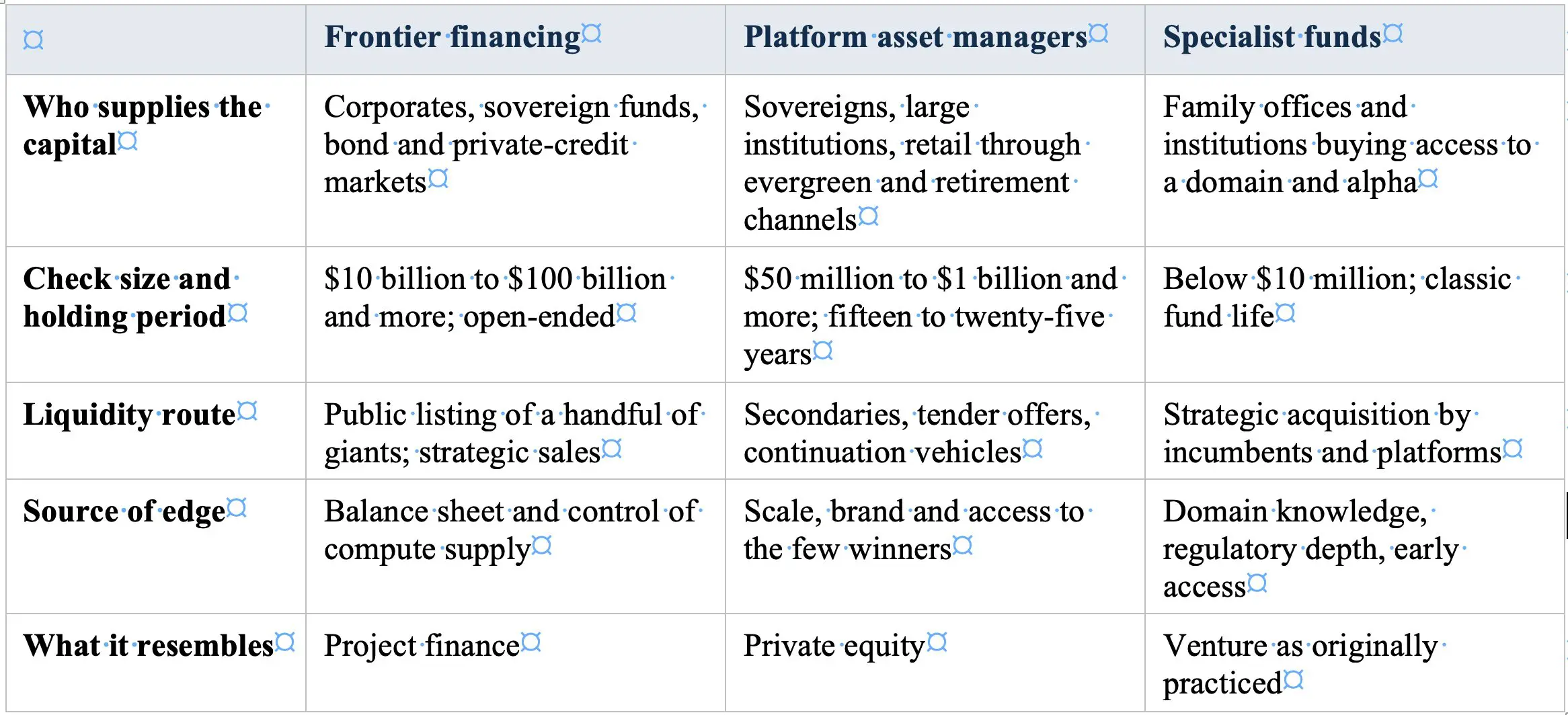
On the other hand, the way we go about our venture business will remain strikingly similar to what we did yesterday. Startups and technology innovation will remain the lifeblood of any economy going forward. That function does not disappear, on the side of startups formation and on the side of venture investors backing those startups. That function moves down the stack, is right sized to smaller checks and earlier stages, while the frontier is financed by the largest companies on earth and a handful of sovereign funds.
Fintech is where the forces meet
Fintech is immunized and even thrives under sovereignty and state involvement, whether through legislation, regulation or investments. After all, sovereignty of payment rails, sovereignty over digital assets, sovereignty around identities are existentially important. Although fintech, like all other verticals is impacted by rates, it will do well under AI disruptions, taking advantage more than being negatively impacted by it – I discussed this at length in sone of our previous posts, see here.
An important point to note, that barbell we suggested above, between mega platforms and small specialized funds are already developing in fintech. KPMG’s Pulse of Fintech puts investments in the first half of 2026 at $103.1 billion, but $67.9 billion of that is M&A, including a single $24.3 billion payments acquisition; venture is $31.5 billion; corporate venture deal volume is at its lowest since 2017; EMEA fell 37% half on half. [38] Crunchbase’s narrower count has fintech venture at $28.6 billion for the same period, up 22.7% year on year while deal count fell 25.7% and sits 40% below two years earlier. [14] CB Insights recorded 762 deals in the first quarter, a multi-year low, with deal count down in seven of the last eight quarters; the notable exits were strategic, Capital One buying Brex for $5.15 billion and Mastercard buying BVNK for $1.8 billion. [39] The IPO class of 2025 tells the same story. Chime, valued at $18.4 billion at listing, ended the year back at its $27 offer price, while Circle, whose revenue is reserve yield, traded around $80 against a $24–26 range. [40] Public markets still have appetite for fintech assets that are appropriately priced, while M&A activity will remain healthy as incumbent financial service providers are arming themselves at an accelerated rate in order to ensure their survival.
The venture-scale opportunities move to where the forces are laying new infrastructure: the plumbing of regulated private money and tokenized assets, identity and compliance for agents transacting on behalf of people and firms, and the settlement layer between the two. These companies are regulated, they need balance sheets and licenses, and most will be acquired by incumbents or become infrastructure rather than list as growth stocks. That demands regulatory depth, capital-structure fluency and patience, and it favors specialists over generalists. Specialists are the only ones able to read the fintech and finserv tea leaves.
MiddleGame Ventures: positioning
We have long held that digital wallets, artificial intelligence and tokenization converge toward an onchain financial system in which assets, identities and transactions become intelligent. The forces described here support the direction and sharpen the path: it runs through Washington, Frankfurt, Paris and Luxembourg as much as through product and business models.
We draw four conclusions for our own practice. First, we stay a specialist. The middle of the barbell is where venture funds are being challenged, and a European fintech investor with regulatory depth sits on the right side of that trade. Second, we underwrite capital efficiency, not capital consumption: a company that reaches revenue with a small team and modest capital is worth more to us than one that needs a large round to prove itself. Third, we underwrite the exit as a private or strategic event. Our models assume acquisition by incumbents or secondary sales and tender offers, not a plethora of public listing within a short period of time. Fourth, we treat policy as a variable to be analyzed rather than noise to be ignored. Stablecoin rules, digital euro design and agent-authorization standards decide which infrastructure companies get built, and we intend to be early where these frameworks create new categories.
I will end this analysis with a counterargument, for the sakes of opening up a dialogue with readers. What if I am wrong and the dislocation we are witnessing is just temporary, which means that we will get back to business as usual when the AI craze subsidies, when interest rates abate, when liquidity returns like water to an eternal well? What do you think? What is your bet?
References and data notes
The barbell framework and the three-business reading of the asset class are our own analysis. Figures retain the dates, geographies and definitions of their sources; PitchBook, Crunchbase, KPMG and CB Insights count venture activity differently and their totals are not interchangeable.
[1] Advisor Perspectives. Fed’s Interest Rate Decision: September 16, 2026. https://www.advisorperspectives.com/dshort/updates/2026/09/16/feds-interest-rate-decision-september-16-2026
[2] CNBC. 10-year Treasury yield hits 5% before reversing as traders await Fed meeting. September 14, 2026. https://www.cnbc.com/2026/09/14/10-year-us-treasury-is-closing-in-on-5percent.html
[3] International Monetary Fund. Global Financial Stability Report, April 2026. https://www.imf.org/en/publications/gfsr/issues/2026/04/14/global-financial-stability-report-april-2026
[4] World Bank. Strait of Hormuz disruption sends oil prices surging. Data Blog, May 7, 2026. https://blogs.worldbank.org/en/opendata/strait-of-hormuz-disruption-sends-oil-prices-surging
[5] Congressional Budget Office. The Budget and Economic Outlook: 2026 to 2036. February 11, 2026, as summarized by the American Action Forum. https://www.cbo.gov/publication/62105 and https://www.americanactionforum.org/insight/highlights-of-cbos-february-2026-budget-and-economic-outlook/
[6] PitchBook. Global venture data for 2025, as reported by SiliconANGLE, “PitchBook: AI dominates global venture capital as 2025 deal value nears record.” January 7, 2026. https://siliconangle.com/2026/01/07/pitchbook-ai-dominates-global-venture-capital-2025-deal-value-nears-record/
[7] PitchBook. 12 firms collected over 50% of all venture cash in the first half of 2025. July 15, 2025. https://pitchbook.com/news/articles/us-venture-capital-firm-concentration-first-half-2025-founders-fund
[8] US Securities and Exchange Commission statistics on reporting issuers and listed companies, as cited by TheCorporateCounsel.net, September 3, 2025. https://www.thecorporatecounsel.net/blog/2025/09/the-decline-of-public-companies-stats-from-the-sec.html
[9] PitchBook. Q2 2026 US VC Fundraising and Returns Report. August 4, 2026. https://pitchbook.com/news/reports/q2-2026-us-vc-fundraising-and-returns-report
[10] PitchBook. Q1 2026 Quantitative Perspectives: The Magnificent Few. March 16, 2026. https://pitchbook.com/news/reports/q1-2026-quantitative-perspectives-the-magnificent-few
[11] NPR. SpaceX blasts off with a record-breaking $75 billion IPO. June 11, 2026. https://www.npr.org/2026/06/11/nx-s1-5853199/spacex-ipo-price-elon-musk
[12] Carta. VC Fund Performance: Q2 2025. September 23, 2025. https://carta.com/data/vc-fund-performance-q2-2025/
[13] Jefferies. 2025 Global Secondary Market Review: Another Record-Breaking Year. https://www.jefferies.com/insights/the-big-picture/2025-global-secondary-market-review-another-record-breaking-year/
[14] Crunchbase News. Fintech Funding Surges 23% In H1 2026 As Investors Concentrate Their Bets On AI And Financial Infrastructure. July 15, 2026. https://news.crunchbase.com/fintech/funding-rises-deals-slump-h1-2026/
[15] The White House. Democratizing Access to Alternative Assets for 401(k) Investors. Executive Order, August 2025. https://www.whitehouse.gov/presidential-actions/2025/08/democratizing-access-to-alternative-assets-for-401k-investors/
[16] US Department of Labor. Proposed rule on alternative investments in 401(k) plans, March 30, 2026; summary by Morrison Foerster, April 2026. https://www.dol.gov/newsroom/releases/ebsa/ebsa20260330 and https://www.mofo.com/resources/insights/260403-dol-proposed-rule-401-k-alternative-assets
[17] Crunchbase News. Global Startup Investment Hit Record $510B In H1 2026 As AI Boom Accelerates Funding And Exits. July 2, 2026.https://news.crunchbase.com/venture/global-startup-exits-ipo-ma-soar-ai-q2-h1-2026/
[18] Crunchbase News. Venture Funding To Foundational AI Startups In Q1 Was Double All Of 2025. April 2, 2026. https://news.crunchbase.com/venture/foundational-ai-startup-funding-doubled-openai-anthropic-xai-q1-2026/
[19] PitchBook. 41% of all VC dollars deployed this year have gone to just 10 startups. August 8, 2025. https://pitchbook.com/news/articles/41-of-all-vc-dollars-deployed-this-year-have-gone-to-just-10-startups
[20] Futurum Group. AI Capex 2026: The $690B Infrastructure Sprint. February 12, 2026. https://futurumgroup.com/insights/ai-capex-2026-the-690b-infrastructure-sprint/
[21] OMFIF. Sovereign funds are becoming the new venture capitalists. December 17, 2025. https://www.omfif.org/2025/12/sovereign-funds-are-becoming-the-new-venture-capitalists/
[22] Revelio Labs. Startups Are Hiring Less and Raising More. October 2025. https://www.reveliolabs.com/news/tech/startups-are-hiring-less-and-raising-more
[23] PitchBook, citing Carta data. AI is shrinking startup teams. New hires are cashing in. May 8, 2026. https://pitchbook.com/news/articles/ai-is-shrinking-startup-teams-new-hires-are-cashing-in
[24] Stripe. Indexing the AI economy. https://stripe.com/guides/indexing-the-ai-economy
[25] 24/7 Wall St. AI Crushed Software Stocks. IGV Is Betting the ‘SaaSpocalypse’ Is Overblown. July 6, 2026. https://247wallst.com/personal-finance/2026/07/06/ai-crushed-software-stocks-igv-is-betting-the-saaspocalypse-is-overblown/
[26] Çakır Melek, N. and Miller, S. A New U.S. Productivity Chapter? What Industry Data Say About AI. Federal Reserve Bank of Kansas City, Economic Bulletin, February 11, 2026. https://www.kansascityfed.org/research/economic-bulletin/a-new-us-productivity-chapter-what-industry-data-say-about-ai/
[27] Inc. 6 Venture Capital Firms Now Dominate Startup Financing. June 25, 2026. https://www.inc.com/brian-contreras/venture-capital-firms-startup-financing-founders-entrepreneurs-a16z-thrive-lightspeed/91327488
[28] The Budget Lab at Yale. State of U.S. Tariffs: April 8, 2026. https://budgetlab.yale.edu/research/state-us-tariffs-april-8-2026
[29] Dealroom and NATO Innovation Fund. European Defence, Security & Resilience Startups Smash Record with $8.7B Raised in 2025. February 10, 2026. https://www.nif.fund/news/dealroom-and-nato-innovation-fund-european-defence-security-resilience-startups-smash-record-with-8-7b-raised-in-2025/
[30] CoinDesk. The EU Parliament approves digital euro framework to counter U.S.’s payment monopoly. June 23, 2026. https://www.coindesk.com/policy/2026/06/23/european-parliament-clears-last-step-for-a-digital-euro-to-break-u-s-payment-grip
[31] Lerner, J. The venture capital challenge for Europe. CEPR VoxEU, February 20, 2026. https://cepr.org/voxeu/columns/venture-capital-challenge-europe
[32] OECD. Employment Outlook 2025: Setting the scene—Demographic change, economic growth and intergenerational inequalities. July 2025. https://www.oecd.org/en/publications/2025/07/oecd-employment-outlook-2025_5345f034/full-report/component-6.html
[33] Atomico. State of European Tech 2025, as summarized by Invest Europe, November 19, 2025. https://www.investeurope.eu/news/newsroom/state-of-european-tech-2025-a-roadmap-to-unlock-further-tech-growth/
[34] Stablecoin Beat. Stablecoin Market Cap Tracker, accessed September 16, 2026. https://stablecoinbeat.com/tracker/
[35] US Department of the Treasury. Treasury Seeks Public Comment on GENIUS Act Proposed Rulemaking. August 17, 2026. https://home.treasury.gov/news/press-releases/sb0605
[36] crypto.news, citing RWA.xyz. Tokenized real world assets triple to $34 billion as Treasuries and Ethereum lead. May 25, 2026. https://crypto.news/tokenized-real-world-assets-triple-to-34-billion-as-treasuries-and-ethereum-lead/
[37] Payments Dive. Visa, Mastercard jockey to set agentic standards. March 5, 2026. https://www.paymentsdive.com/news/visa-mastercard-jockey-to-set-agentic-standards/813910/
[38] KPMG. Pulse of Fintech H1 2026. August 2026. https://kpmg.com/xx/en/what-we-do/industries/financial-services/pulse-of-fintech.html
[39] CB Insights. State of Fintech Q1’26 Report. April 23, 2026. https://www.cbinsights.com/research/report/fintech-trends-q1-2026/
[40] American Banker. Top 5 fintech IPOs of 2025. December 30, 2025. https://www.americanbanker.com/payments/news/top-5-fintech-ipos-of-2025