Private Equity Becomes a Shadow Balance Sheet
The forces pulling venture capital apart are pushing private equity toward credit, insurance and the retail saver
Pascal Bouvier | Managing Partner | MiddleGame Ventures | September 2026
I argued in our recent companion piece on developments in venture capital, see here, that five macro forces—higher interest rates, the privatization of the exit, the two-sided effect of AI on capital intensity, the return of the state, and demography—are pulling that asset class into a barbell. [1] Private equity (PE) faces the same five forces. I believe it does not experience them the same way, because PE is a leveraged asset and venture is not. The result is the opposite. Venture splits. Private equity converges and is becoming one product inside diversified balance-sheet businesses whose growth engines are private credit and retirement income.
I endeavor to explain the differences for PE while repeating similarities with our first piece on venture capital when appropriate.
Rates arrive through the debt channel
While venture experiences a higher risk-free rate as a discount on distant cash flows, PE experiences it more directly and faster via recurring interest expenses. Bain calculates that a typical deal once needed about 5% annual EBITDA growth to return 2.5 times invested capital in five years; with borrowing costs of 8–9%, less leverage and record purchase multiples, it now needs 10–12%. Bain calls this “12 is the new 5.” [2] McKinsey puts the median entry multiple at a record 11.8 times EBITDA and the pooled top-quartile buyout IRR for 2025 at 8%, against 18% for the S&P 500 and 22% for the MSCI World. [3] The engine that produced PE returns from 2010 to 2021—cheap debt and expanding multiples—has run in reverse, and even the top quartile performers are feeling the pinch.
The market has paid attention. Closed-end PE fundraising fell 17% in 2025 to $616 billion, with Europe down 41%; fundraising declined for a fourth year, to $395 billion; and about 40% of the industry’s dry powder has been waiting more than two years to be deployed. [2,3] Yet PE deal value rose 44% to $904 billion, with thirteen transactions above $10 billion accounting for 30% of the total. [2] As in venture capital, deployment and fundraising have decoupled, and the gap is filled by capital that is not a traditional fund. The $55 billion privatization of Electronic Arts, the largest all-cash sponsor on record, was led by Saudi Arabia’s Public Investment Fund with $36.4 billion of equity and a $20 billion debt commitment from JPMorgan, the largest buyout debt financing since the global financial crisis; it closed in August 2026. [4,5] Private credit, meanwhile, competes to lend: spreads on new-issue first-lien loans compressed from 716 basis points in 2023 to 544 in 2025. [3] Higher base rates and tighter spreads at the same time tell you where the pressure sits: on the borrower’s coverage ratio, not on the lender’s appetite.
Liquidity is redistributed, not restored
PE’s backlog dwarfs venture’s. Bain counts 32,000 unsold companies worth $3.8 trillion; the average holding period has stretched to about seven years from five or six in 2010–2021; distributions ran at 14% of net asset value in 2025, below 15% for the fourth year running. [2] McKinsey measures distributions at 6% of assets under management in the twelve months to June 2025, against a 2015–19 average of 16%, and PitchBook finds nearly $5 trillion of net asset value—39% of the total—sitting in funds seven years old or more. [3,6] Exits did recover in 2025, to $717 billion, but the growth came from sales to strategic buyers, up 66%, rather than from listings. [2]
Private equity invented the tools venture is now borrowing, and it uses them at a scale that changes their nature. GP-led secondaries reached $115 billion in 2025, continuation vehicles accounted for about 14% of all sponsor-backed exit volume, and single-asset vehicles passed half of that total for the first time. [7] NAV finance adds a second layer: 17Capital reports that 97% of NAV loans executed in 2023 were used to increase investment capacity rather than to fund distributions, at margins of 550–750 basis points over base rates. [8] The evergreen wrapper then moves illiquid assets toward investors who expect liquidity. US semiliquid private equity vehicles doubled since 2023 to $204 billion; US evergreen funds across all strategies hold $607 billion in 567 vehicles; non-traded business development companies went from nothing to more than $200 billion since 2021. [3,9] Quarterly redemption caps of about 5% are the safety valve. Partners Group disclosed redemption requests of 9.8% at one vehicle in the second quarter of 2026, and the Federal Reserve notes that certain BDCs have exercised their limits. [9,10]
The difference with venture capital is the direction of travel. Venture’s liquidity fix moves ownership between institutions or funds and focuses on optimizing the cash flow startups that remain private longer. PE’s fix adds leverage at fund level and shifts illiquid assets toward retail vehicles carrying quarterly redemption promises. Illiquidity is being redistributed, not resolved. That is a material difference.
AI is a risk, a lever and an asset at the same time
As I already argued the impact of AI on venture is dual: a capital sink at the frontier level (larger startups) and a cost collapse at the base (smaller startups). For PE it is three different things at once.
It is the largest risk in the book. Software became the buyout industry’s favorite sector because recurring revenue supports debt. The BIS reports that private credit loans to software companies grew from about $8 billion in 2015 to more than $500 billion by end-2025, 19% of all direct loans, with a third of private credit funds exposed. Software equities fell almost 30% between October 2025 and February 2026 on fears that AI disrupts the software business model, and business development companies with high software exposure underperformed their peers by about five percentage points. [11] Sponsors have stepped back: software platform buyouts ran at $16 billion in the first five months of 2026, a pace of roughly $39 billion for the year against a record $156 billion in 2025, and the platform share of software deal value fell to 41%, the lowest in at least a decade. [12]. Even though a SaaS Armageddon has been oversold, a large exposure to undifferentiated software models, in industries where moats are disappearing, is a very uncomfortable position to be in.
It is the best operating lever the industry has had since cheap debt. If 12 is the new 5, margin has to come from operations, and the most direct route is applying AI to labor-heavy services businesses. Thrive Holdings, in which OpenAI holds a stake, raised $2 billion in July 2026 on top of an earlier $1 billion to buy and re-engineer accounting, IT and other services firms; one of its companies has acquired 48 accounting practices. [13] McKinsey’s survey shows where the incumbents stand: 6% of general partners see high AI impact on their own operations today, 70% expect it within three to five years. [3]
And it is a new asset class. The AI build-out is being financed off the hyperscalers’ balance sheets and onto private capital’s. Meta’s Hyperion campus in Louisiana is owned 80% by Blue Owl funds and 20% by Meta, with about $27 billion of development cost, roughly $7 billion of Blue Owl cash and the balance in debt sold to PIMCO and other bond investors, against a four-year lease backed by a sixteen-year residual value guarantee. [14] McKinsey records data center deal volume up 37% in 2025. [3] This is how the AI capital cycle becomes a private-credit exposure, and why the fate of the frontier matters to those that back PE.
The state opens the retail door. Should it worry?
In the US, the executive order and the Labor Department’s proposed rule that would open 401(k) plans to private assets, described in the companion piece, benefit PE before venture capital. [15,16] Empower, the second-largest US retirement services provider with about $2 trillion under administration and 19 million investors, added Blackstone in January 2026 to a program offering private equity, credit, infrastructure and real estate through collective investment trusts. [17] In Europe, the answer is the ELTIF: €34 billion at end-2025, up 55% in a year, 268 authorized products, 151 of them domiciled in Luxembourg, a third of assets in private debt, three-quarters of products accessible to retail investors. [18]
I doubt that the PE sector has been tested against an economic downturn while it has started to tap into retail savings. The complexity, leverage and interconnectedness of all PE funds and their investments is such that LPs may be hit in ways they never expected. Whenever leverage is excessive, risk tends to lash out painfully. Have US authorities as well as EU ones thought through repercussions on the real economy and aggregate savings and consumption?
Demography funds the liabilities and supplies the assets
This is where PE differs most from venture capital. An aging population does not only demand automation; it demands retirement income, and the annuity is the product. Insurers that sell annuities need long-dated yield, private credit supplies it. Privately owned life insurers held 19.8% of US life industry assets at end-2025, $1.2 trillion, up from 2.5% in 2011; their number rose from 16 to 93; Apollo’s Athene, KKR’s Global Atlantic, Brookfield’s American National and Blackstone’s Everlake are the reference cases. US life insurers as a whole hold about $807 billion of private credit and illiquid investments, up from $685 billion a year earlier. [21]
Demography also supplies the assets. KfW’s monitoring of the German Mittelstand finds roughly 109,000 firms a year seeking a succession arrangement through 2029, and about 114,000 a year—one in four—intending to close for lack of one. [22] Owner retirement is the deal flow of the lower and middle market, and it is a European problem before it is an American one.
Together these two facts make private equity the balance sheet of retirement: the saver’s annuity on one side, the retiring owner’s company on the other, private credit and the buyout fund in between.
What this adds up to
Obviously, PE does not disappear. It becomes a line of business, and the firms that own it are valued on their credit, insurance and retail engines instead. Traditional managers are buying their way in. As an example, BlackRock completed its acquisition of HPS on July 1, 2025, to create a $190 billion private financing platform and named the “convergence of public and private markets” as the rationale. [23] Blackstone’s real estate income trust holds $100 billion and its private credit fund $49 billion; roughly 80% of US evergreen assets sit in credit and real estate rather than in buyouts. [9]
Same forces, different channels
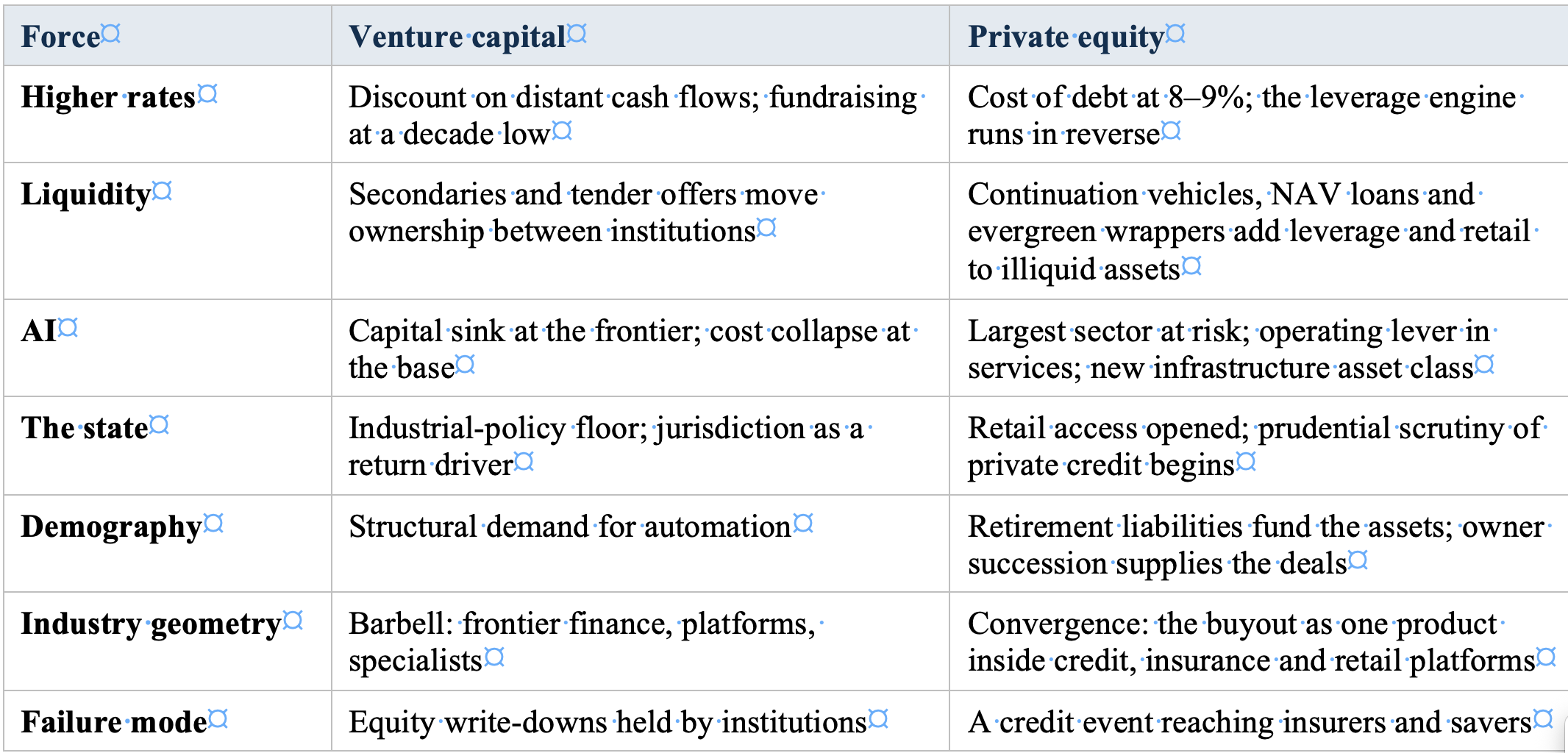
Three consequences follow. First, the buyout returns to operations. With multiple expansion gone, value must come from revenue and margin, which favors sector specialists with operating capability over generalist leverage. Second, the small and mid-market PE general partner without a credit, insurance or retail engine may very well face the squeeze that mid-sized venture fund face: funds above $1 billion took 78.2% of all private-market fundraising in the first half of 2026, up from 59.1% in 2021. [6] Third, and most important, PE’s failure mode is different. A venture cycle ends in equity write-downs. A PE cycle now runs through credit: the same software loan can sit in a BDC sold to savers, in an insurer’s general account backing annuities, and on a bank’s balance sheet as a facility to that BDC. That is the interconnectedness I was alluding to above, and it is why the next downturn in private markets may be a policy event, not only an investment one.
The result is a convergence towards very large PE platforms while smaller GPs in the category fight for oxygen. Not the split I analyzed in venture capital, a symmetrical movement, convergence.
References and data notes
The reading of private equity as a converging balance-sheet business, and the comparison with venture capital, are our own analysis. Figures retain the dates, geographies and definitions of their sources; Bain, McKinsey and PitchBook define deal, exit and fundraising activity differently and their totals are not interchangeable.
[1] Bouvier, P. Venture Capital Splits in Two. MiddleGame Ventures, September 2026.
[2] Bain & Company. Global Private Equity Report 2026, press release: “Private equity resurgence gathers steam as new era challenges firms to enhance value creation.” February 23, 2026. https://www.bain.com/about/media-center/press-releases/2026/private-equity-resurgence-gathers-steam-as-new-era-challenges-firms-to-enhance-value-creationbain–company-global-pe-report/
[3] McKinsey & Company. Global Private Markets Report 2026: Clearer view, tougher terrain. February 2026. https://www.mckinsey.com/~/media/mckinsey/industries/private%20equity%20and%20principal%20investors/our%20insights/mckinseys%20global%20private%20markets%20report/2026/global-private-markets-report-2026-full-report.pdf and https://www.mckinsey.com/industries/private-capital/our-insights/global-private-markets-report
[4] PitchBook. Electronic Arts LBO backed by $20B debt financing commitment. October 2, 2025 (updated June 22, 2026). https://pitchbook.com/news/articles/electronic-arts-lbo-backed-by-20b-debt-financing-commitment
[5] Public Investment Fund. Electronic Arts announces completion of acquisition by PIF, Silver Lake, and Affinity Partners. August 4, 2026. https://www.pif.gov.sa/en/news-and-insights/newswire/2026/electronic-arts-announces-completion-of-acquisition-by-pif-silver-lake-and-affinity-partners/
[6] PitchBook. Q2 2026 Global Private Market Fundraising Report. September 3, 2026. https://pitchbook.com/news/reports/q2-2026-global-private-market-fundraising-report
[7] Jefferies. 2025 Global Secondary Market Review: Another Record-Breaking Year. https://www.jefferies.com/insights/the-big-picture/2025-global-secondary-market-review-another-record-breaking-year/
[8] 17Capital. A tool for growth. November 1, 2024 (originally in Private Debt Investor). https://www.17capital.com/insights/a-tool-for-growth
[9] Dakota. Top 10 Evergreen Funds in Private Markets: Q2 2026. July 29, 2026. https://www.dakota.com/resources/blog/top-10-evergreen-funds-in-private-markets-q2-2026
[10] Board of Governors of the Federal Reserve System. Financial Stability Report, May 2026. https://www.federalreserve.gov/publications/files/financial-stability-report-20260508.pdf
[11] Bank for International Settlements. Private credit’s software lending meets AI disruption. BIS Quarterly Review, March 16, 2026. https://www.bis.org/publ/qtrpdf/r_qt2603v.htm
[12] PitchBook. PE pivots as platform buyouts in software fall to decade low. June 25, 2026. https://pitchbook.com/news/articles/pe-pivots-as-platform-buyouts-in-software-fall-to-decade-low
[13] PYMNTS. Thrive Holdings Raises $2 Billion to Buy and Rewire Services Firms With AI. July 6, 2026. https://www.pymnts.com/news/artificial-intelligence/2026/thrive-holdings-raises-2-billion-to-buy-and-rewire-services-firms-with-ai/
[14] Meta Platforms. Meta Announces Joint Venture with Funds Managed by Blue Owl Capital to Develop Hyperion Data Center. October 21, 2025. https://www.prnewswire.com/news-releases/meta-announces-joint-venture-with-funds-managed-by-blue-owl-capital-to-develop-hyperion-data-center-302590584.html
[15] The White House. Democratizing Access to Alternative Assets for 401(k) Investors. Executive Order, August 2025. https://www.whitehouse.gov/presidential-actions/2025/08/democratizing-access-to-alternative-assets-for-401k-investors/
[16] US Department of Labor. Proposed rule on alternative investments in 401(k) plans. March 30, 2026. https://www.dol.gov/newsroom/releases/ebsa/ebsa20260330
[17] Empower. Empower partners with Blackstone for private markets investments. January 14, 2026. https://www.empower.com/press-center/empower-partners-blackstone-private-markets-investments
[18] Scope Fund Analysis. ELTIF Study 2026. April 16, 2026. https://saprodscopeexplorer01.blob.core.windows.net/public/reports-links/Scope_ELTIF_study_2026.pdf
[19] Financial Stability Board. Report on Vulnerabilities in Private Credit. May 6, 2026. https://www.fsb.org/2026/05/report-on-vulnerabilities-in-private-credit/
[20] Investing.com. Private Credit in 2026: Record Defaults, Softer Returns and New Regulatory Focus (citing Fitch, Proskauer, Moody’s and Cliffwater). August 26, 2026. https://www.investing.com/analysis/private-credit-in-2026-record-defaults-softer-returns-and-new-regulatory-focus-200686600
[21] Insurance Business, citing ALIRT Insurance Research. Privately-owned insurers now hold nearly 20% of US life industry assets. July 9, 2026. https://www.insurancebusinessmag.com/us/news/life-insurance/privatelyowned-insurers-now-hold-nearly-20-of-us-life-industry-assets–alirt-581927.aspx
[22] KfW Research. Nachfolge-Monitoring Mittelstand 2025. January 9, 2026. https://www.kfw.de/%C3%9Cber-die-KfW/Newsroom/Aktuelles/News-Details_876800.html
[23] BlackRock. BlackRock Completes Acquisition of HPS Investment Partners. July 1, 2025. https://www.blackrock.com/corporate/newsroom/press-releases/article/corporate-one/press-releases/blackrock-acquires-hps-investment-partners
[24] MiddleGame Ventures. Our Investment in Fundcraft. November 4, 2024. https://www.middlegamevc.com/articles/our-investment-in-fundcraft/